| Riley Lee | ![]() |
International Shakuhachi Society | ||
| Tai Hei Shakuhachi | ![]() |
Savour the Flavour of India | ||
History/Links/Promotional Material
Shakuhachi Background
History
Of Chinese origin, the Shakuhachi was introduced to Japan during the Nara period in about the 8th century along with other instruments of the Gagaku (court music).
Construction:
The standard Shakuhachi is a bamboo wind instrument usually with five holes (four at the front and one at the back) and 54.5 centimeters long. There are variations with 7 or 9 holes and of different lengths.
Shakuhachi have a special mouthpiece, which used to be made of horn, but is now more commonly made of hard plastic.
The instrument is end blown with the bamboo slightly bowed and tapering away from the bamboo root which forms the bell. The outside thickness varies, however the inside diameter is carefully regulated.
Performance Practice
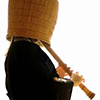
Shakuhachi were originally used in sacred music played by Zen Buddhist monks. The instrument is particularly connected with the Komuso (rice straw priests). These were beggar priests who wandered Japan during the Muromachi Period - 14th to 16th centuries. Some were known to wear a straw basket over their heads to hide their identity, as they were spies, The Shakuhachi came in handy not only as a musical instrument but also as a weapon.
By the Edo period - 17th - 18th centuries - Shakuhachi playing had moved into the secular realm featuring solos and ensembles with Koto and other instruments. Modern practice sees the Shakuhachi used in various groupings including with western instruments, however traditional solo music is also very popular.
Promotional Images |
||||
![]() |
![]() |
![]() |
||
498K |
746K |
442K |
221K |
|
Click on the thumbnail image to download a larger file. Please contact me if you need bigger files |
||||